Advice
Buying a finca in the Canary Islands: rustic land, water, licences
A finca isn't bought like an apartment: what matters is the land's classification, the water, and the history of what's built on it.

Luca, in the Canaries since 2014
Updated on · 6 min read
In brief
A finca in the Canary Islands is land before it's a house, and the land decides almost everything. Canarian planning law says any land that isn't classified as urban or developable is rustic, and there housing is an ordinary use only within asentamientos. Water is a chapter of its own. Before any offer, I check the land's classification, the water, and the legality of what's already built.
In this guide 6 sections
What a finca is, and why it isn't a house with a garden
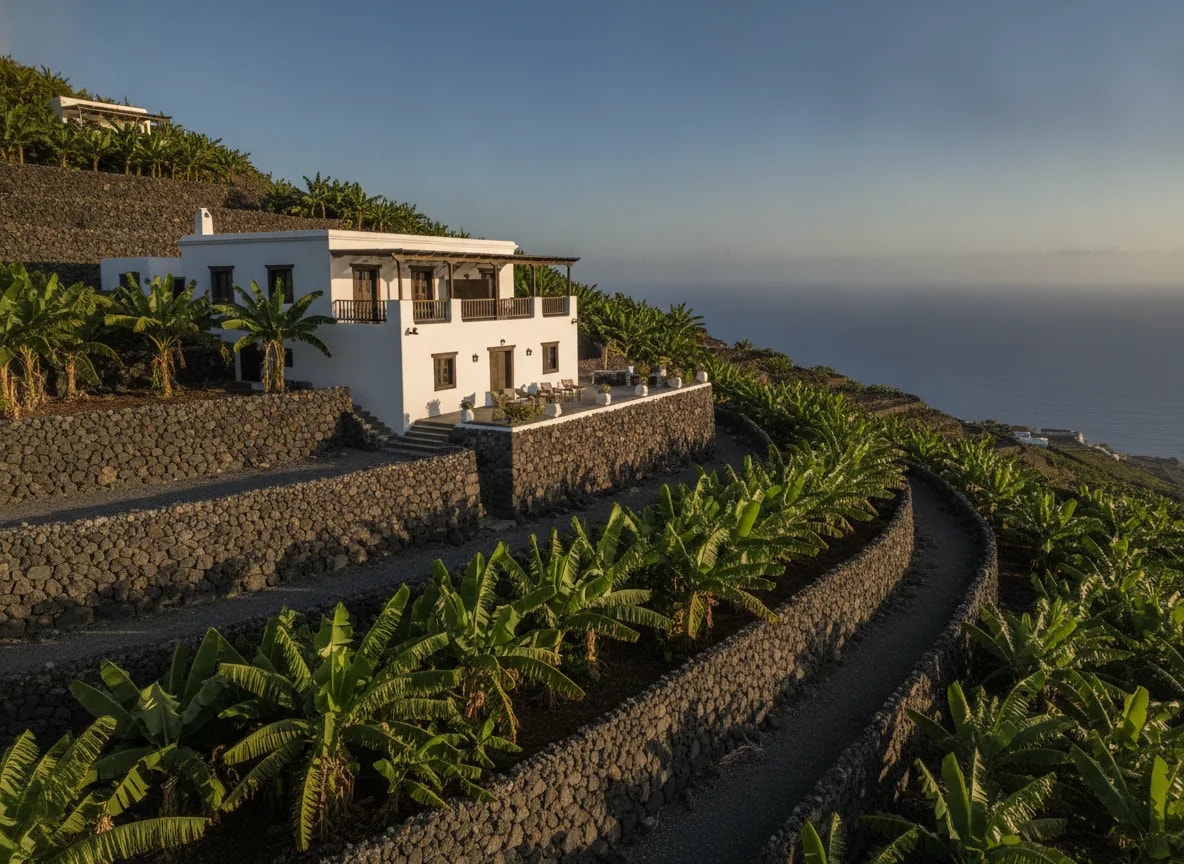
In Spanish legal language, a finca is the property unit recorded at the Registro, the Spanish land registry: it can be an apartment just as much as a piece of land. But the way the word is used here, a finca means a patch of countryside: a plot with fruit trees, vines or banana trees, perhaps a storeroom and an old house. People who ask me about one are looking for space, quiet and land to cultivate.
The difference from an apartment isn't the size: on a finca, the value and the limits sit in the land. Before I even look at the photographs, I check the plot's planning classification, because that's what tells you whether the house can be extended, whether another one can be built, whether it can be let to tourists, and even whether what's already there is legal.
Rustic land: what you can and can't do
The 2017 Canarian planning law puts it in one dry sentence: in general, any land not classified as urban or developable is rustic land. But «rustic» isn't a single category, and the categories make a real difference.
- Environmentally protected rustic land: natural, scenic, cultural, buffer-zone, coastal. It's the most restricted, for a reason I explain further down.
- Economically protected rustic land: agricultural, forestry, hydrological, mining. This is «working» land: farming is its proper use.
- Settlement rustic land: rural settlements (asentamiento rural), where there's already a built-up nucleus, and agricultural settlements (asentamiento agrícola), where the houses grew up alongside the crops.
- Infrastructure-protection rustic land, for roads, networks and buffer strips.
The ordinary uses on rustic land are agricultural, livestock, forestry, hunting, fishing, grazing, extractive and infrastructure. Tourism isn't among them: it can only come in as a use complementary to a genuine farming activity, in which case the law requires it to take place in buildings already standing on the finca, in a legally consolidated position or outside the planning order (fuera de ordenación), and to be run by a professional farmer, a cooperative or an agricultural company. Or it can come in as a project of public or social interest: exceptional, and not authorisable on environmentally or agriculturally protected land.
A house on rustic land: where it's allowed, and on what conditions
It's the question everyone asks me. The law answers with three conditions together.
- It has to be within a settlement Residential use is an ordinary use only on land classified as a rural or agricultural settlement, subject to regulatory exceptions for the oversight of protected areas. Outside those areas, housing isn't a proper use of rustic land.
- In agricultural settlements you need the farming activity There the house has to be tied to a genuine crop, and first occupation is only possible once you show the land has been brought into cultivation or that the farming activity continues.
- The plot stays tied to the house The plot supporting the house has to be a unit fit for building, and it stays wholly tied to the authorised house: it can't later be split up and sold off in pieces.
Two useful exceptions: where there are vineyards, wineries and installations linked to that activity can be authorised in any category of rustic land, if the island's planning instrument doesn't forbid it; and the law provides for the restoration of buildings of ethnographic or architectural value, even outside the planning order, to be used as housing or for tourism.
Water: the question almost nobody asks in time
The Canarian water law sets up a Consejo Insular de Aguas on every island, a public-law body with its own legal personality, attached to the Cabildo: it's the body that issues concessions and authorisations and keeps the island's water Register and Catalogue.
- The Registro de Aguas on each island records the titles that legitimise concession-based water use and any temporary use of private water.
- The Catálogo gathers the water classified as private under earlier legislation, and the law states its entries have declaratory effect.
- The law recognises the legal personality of the Canary Islands' Heredamientos and Comunidades de Aguas, the historic water guilds and water companies: in many valleys, they're the ones who own and distribute the water, in turns and shares.
In practice: the water that irrigates a finca often doesn't belong to the finca. It can come from a share in a water community, from a turn bought separately, from an agreement with the neighbour that was never put in writing. When I take a client to see a finca, I ask three things before we talk price: where the water comes from, who holds title to it and under what document, and whether that right transfers with the sale.
Existing buildings, and legality
On fincas you find storerooms, sheds, pools and extra rooms built without a permit. Canarian law gives the administration four years from a building's completion to begin restoring planning legality; once that deadline passes, the building doesn't become legal: it stays outside the planning order (fuera de ordenación).
- On a property that's outside the planning order, you can only carry out the repair and maintenance work needed for habitability, accessibility and appearance, without increasing the volume or height.
- The four-year limit doesn't apply to everything: it doesn't cover illegal land divisions on protected rustic land or within a protected natural area, nor buildings on environmentally protected rustic land. There, the power to order restoration never lapses.
- On fincas, even within settlements, houses and stables must have a treatment plant or an individual septic tank: cesspits are banned.
My method is simple: I compare what I see with the nota simple, the extract from the land registry, with the cadastral certificate and with what the town hall has on record. If the house we're standing in doesn't show up anywhere, that's the first thing to sort out: it changes both the value and whether you can buy with a mortgage.
The extra checks, compared with an apartment
- The cédula urbanística from the town hall: the land's classification and category, permitted uses, buildable area. It's the document that answers «what can I do with this».
- Whether the plot sits within a protected natural area: there, the area's own management instrument takes precedence, and it's stricter than the town's local plan.
- The water: title, source, share, turns, confirmation from the Consejo Insular de Aguas.
- Access: is the road that leads to the property public, or is it a right of way over someone else's land? A right of way shows up in the nota simple, not in what you're told.
- The surface area: the figures in the Registro, the Catastro and an actual survey almost never match. It's worth reconciling them before you sign.
- Holiday letting: in agricultural settlements the 2025 Canarian law doesn't allow it to be licensed at all, and in rural settlements it sets very low maximum densities. If you're buying to let, that answer comes before the price.
This is general guidance, written from the official sources listed at the foot of the page: it isn't legal, planning or tax advice. On rustic land, the answer depends on the island's planning instrument, the town's own plan and the individual plot: for your own case, consult a qualified professional and a lawyer, and confirm with the town hall and the Consejo Insular de Aguas.
Frequently asked questions
Can I build a house on a finca in the Canary Islands?
Only if the plot is classified as a rural or agricultural settlement: there, a single-family house is an ordinary use. In agricultural settlements it has to be tied to a genuine crop, and the finca stays legally linked to the authorised house.
Is the water included in the price of a finca?
Don't assume it is. In the Canary Islands, water rights often belong to heredamientos or water communities, recognised under Canarian water law, and travel separately from the land. Ask for the title and its source, and confirm with the Consejo Insular de Aguas.
Can a building without a permit be legalised over time?
No. Once the time limits have passed, the administration can no longer order its demolition, but the property stays outside the planning order: only repair and maintenance work is allowed, without increasing its volume or height. And on environmentally protected rustic land those time limits don't apply at all.
Can I let a house on rustic land to tourists?
Not in agricultural settlements: the 2025 Canarian law rules it out. In rural settlements it's possible but with very low maximum densities, and in every case it's the town's own urban plan that has to expressly allow that use.
Sources
- Ley 4/2017 del Suelo y de los Espacios Naturales Protegidos de Canarias, testo consolidato (BOE) (opens in a new tab) accessed on
- Ley 12/1990, de 26 de julio, de Aguas (Canarias), testo consolidato (BOE) (opens in a new tab) accessed on
- Ley 6/2025, de 10 de diciembre, de Ordenación Sostenible del Uso Turístico de Viviendas (BOC 246, de 12.12.2025), testo su BOE (opens in a new tab) accessed on
Tax and legal information here is general guidance, not advice: for your own situation, consult a qualified professional.
Read next
 Holiday rentals in the Canary Islands: the vivienda vacacional licence Laws and regulations
 Nota simple: how to read it before making an offer Useful information
 La Palma after the volcano: buying a house on the green island Renting and selling
 Buying property in the Canaries: the guide the reference page
Images marked AI are generated with artificial intelligence.