Advice
Building a house in the Canary Islands or buying one ready-built: what changes
If you buy a ready-built house, you sign a deed. If you build, you go through a plot, a licence, a building site and a final declaration, each with its own rules.

Luca, in the Canaries since 2014
Updated on · 7 min read
In brief
Building a house in the Canary Islands means buying a buildable plot, getting a licence from the council (no answer within three months counts as a no), paying the building tax (ICIO) and IGIC on the works and finally declaring the finished house before a notary. Buying ready-built skips all these steps. Before recommending either route, I check the land: that's where it's decided.
In this guide 7 sections
- Two routes that don't compare on price alone
- The plot: when it counts as a «solar»
- The licence: three months, and silence counts as a no
- The taxes you pay when you build
- Ten-year insurance: not if you build for yourself, until you sell
- Completion and first occupation
- If you're not a European Union citizen
Two routes that don't compare on price alone
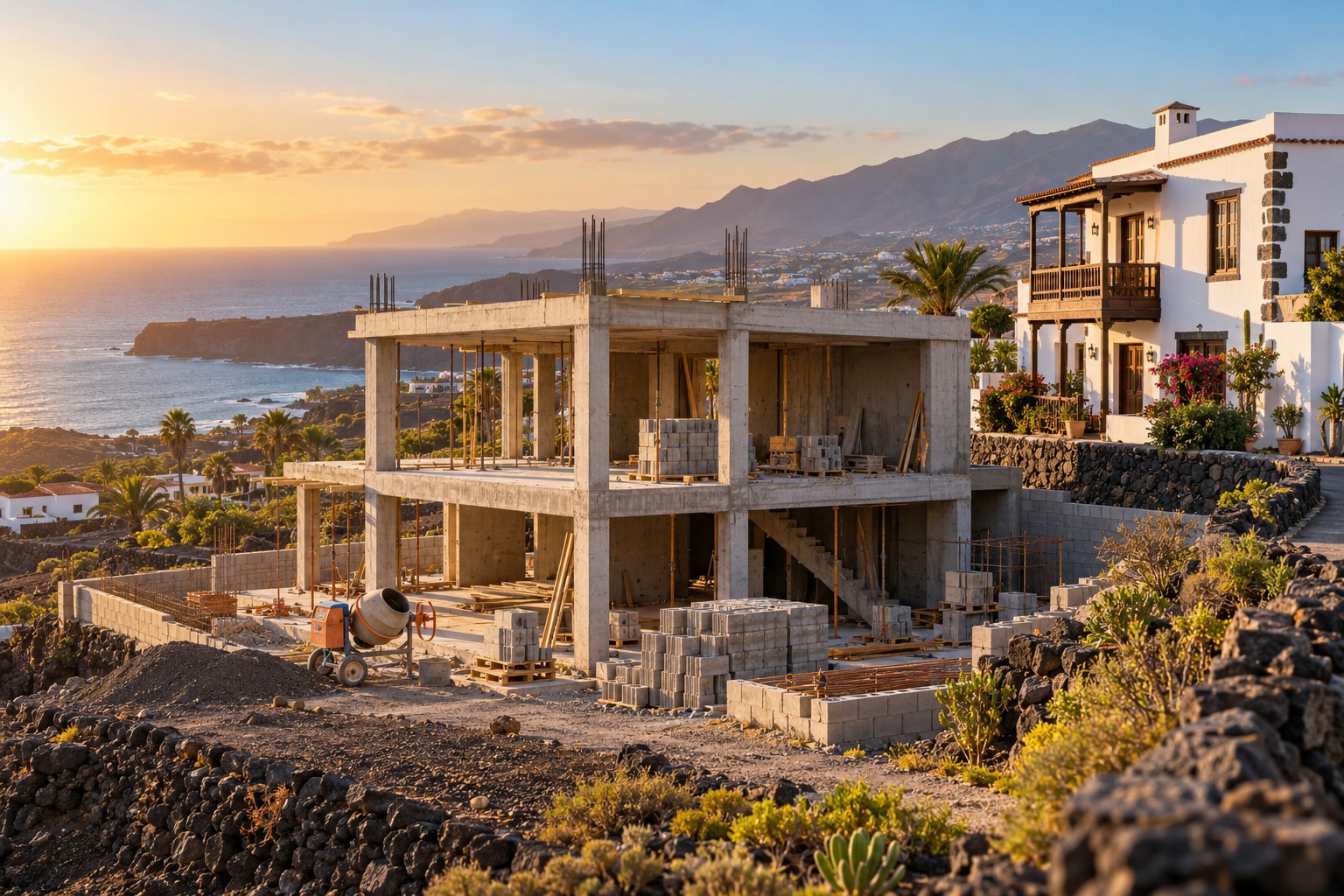
When people ask me whether it's better to build or to buy, the first thing I do is line up the steps of the two routes, because they aren't the same length. Buying a ready-built house comes down to a contract: you check the property, sign at the notary's and pay the purchase taxes. Building is a series of formal steps, each with its own authority and its own taxes.
- The plot You buy land on which the law allows a house to be built, and that purchase has its own taxes too.
- The licence The council has to authorise the building before work on site starts: anyone buying a ready-built house doesn't need one.
- Construction You pay the building tax (ICIO) to the council, and IGIC, the Canary Islands' indirect tax, on the builder's invoices.
- Completion The director of works and the director of execution of the works sign the final completion certificate (certificado final de obra), the first occupation is notified to the council, and the house is declared before a notary.
The plot: when it counts as a «solar»
Not every piece of urban land is ready for a house. Canarian land law uses the word «solar» (Spanish for a building plot) for urban land that's fit for building and already has four services, and those are the first things I check:
- access from a paved road open to public use;
- drinking water and electricity, with enough flow and power for what you want to build;
- drainage of waste water into the sewer, or into a treatment system with enough capacity;
- pedestrian access, a pavement or equivalent, and street lighting on at least one of the roads around it.
Rustic land is another story: there, a house is an ordinary use only in rural or agricultural settlements (asentamientos rurales o agrícolas), and in the agricultural ones it has to be tied to a genuine crop. I explain it in full in the guide to buying a finca, which is worth reading before you make an offer on land outside a built-up area.
Buying the plot also carries its own taxes, under the same rule as houses. If a private individual is selling, you pay ITP, the property transfer tax. If a business is selling and the land is buildable, the sale is subject to IGIC, because Canary Islands law exempts from IGIC only rustic land and land that can't be built on.
The licence: three months, and silence counts as a no
Construction and building works for new structures require a planning licence (licencia urbanística), and it's the council that grants it. Anyone buying a ready-built house doesn't need one: the permit concerns whoever is building.
The council has three months from the date of the application to decide and notify its answer; municipal bylaws can shorten that period, but not extend it. Here lies the rule that most often comes as a surprise: for building works, silence is negative (silencio negativo). If the three months pass without a written answer, you can consider the application refused, not approved.
Negative silence doesn't close the file: it allows you to appeal against the council's inaction, and the council remains obliged to decide. For anyone planning a timetable, it means the three months are a legal time limit, not the date work starts.
The taxes you pay when you build
Anyone buying a ready-built house pays the purchase taxes: ITP on a resale bought from a private individual, IGIC plus AJD (the duty on notarial deeds) on a new build bought from the developer. Anyone who builds pays others, at different times, and in the cost estimate I keep them on separate lines:
- Whoever builds pays the council ICIO, the building tax, on the material execution cost of the work: each council sets the rate, and it can't exceed 4%. The base excludes IGIC, the municipal fees linked to the work, professional fees and the builder's profit. The tax falls due when work begins, even if the licence hasn't been granted yet.
- On the builder's invoices you pay IGIC at the general rate of 7%. Canary Islands law provides a zero rate for construction work only when the house is officially protected housing (vivienda de protección oficial), and the reduced rate for a habitual residence concerns people buying a new house, not people having one built.
- On the notarial deed that declares the house built (the declaración de obra nueva) you pay AJD at 0.75%. The base is the real cost value of the work.
These are figures set by law, not an estimate: the ICIO rate changes from one council to another, and the cost of the work comes from the project. For comparison, the taxes on buying a ready-built house are in the Taxes and costs guide, and those on a new build bought from the developer in the guide to buying a new build.
Ten-year insurance: not if you build for yourself, until you sell
Anyone buying a new house from the developer receives the ten-year guarantee on the structure: for buildings intended as homes, the law makes it compulsory. Anyone building a single-family house for themselves, as the sole self-developer (autopromotor), is exempt from it.
The exemption, though, lasts only as long as the house stays yours. If you sell it before ten years have passed, you have to take out the guarantee for the years remaining, unless agreed otherwise. The notary won't authorise the sale deed, and the Registro de la Propiedad (the land registry) won't record it, without proof of the guarantee, unless the buyer expressly releases you from it and you show that you have lived in the house.
The ten years run from the handover certificate (acta de recepción), the document with which the builder hands the finished house over to whoever commissioned it.
Completion and first occupation
When the house is finished, the builder hands it over with a handover certificate signed at least by the builder and by whoever commissioned the work. It records the date of the final completion certificate and the final execution cost of the work, and the final completion certificate, signed by the director of works and the director of execution, is attached to it.
To live in it, in the Canary Islands you don't need a second licence: the first occupation of a finished building is subject to prior notification to the council (comunicación previa). Then you go to the notary for the declaración de obra nueva, the deed that declares the building constructed on the land.
If you're not a European Union citizen
All of Spain's islands and islets are zones where foreigners' access to property is restricted. If you're not a citizen of a European Union member state, buying land or a house, rustic or urban, requires military authorisation, and so does building. For EU citizens these limits don't apply.
It's a step that applies to both routes, but anyone who builds meets it twice: when buying the plot and when building. The exception is centres and zones declared of national tourist interest, where authorisation is deemed granted within the limits set by the Ministry of Defence.
This is general guidance on rules and taxes, not legal, tax or technical advice. The plot, the project and the position of whoever is building need to be checked case by case with an architect and with a qualified professional in Spain.
Frequently asked questions
Do I need planning permission to build a house in the Canary Islands?
Yes. Construction and building works for new structures require a planning licence (licencia urbanística), granted by the council. The council has three months to answer: bylaws can shorten that period, not extend it.
If the council doesn't reply within three months, can I start building?
No. For building works the council's silence is negative: once the three months have passed, you can consider the application refused. You can appeal against the inaction, and the council remains obliged to decide.
Do I need ten-year insurance if I build my own house?
No, if you're an individual self-developer (autopromotor) building one single-family house for your own use. But if you sell it within ten years of the handover of the work, you have to take out the guarantee for the time remaining, unless agreed otherwise, or unless the buyer expressly releases you from it and you show you have lived in the house.
What taxes do you pay to build a house in the Canary Islands?
ICIO to the council, up to 4% of the material execution cost; IGIC at 7% on the invoices for the work, because the zero rate applies only to officially protected housing; AJD at 0.75% on the obra nueva deed. Plus the taxes on buying the plot.
Can a non-EU citizen build a house in the Canary Islands?
Yes, but they need military authorisation, both to buy the plot and to build: the islands are zones where foreigners' access to property is restricted. For European Union citizens these limits don't apply.
Sources
- Ley 4/2017 del Suelo y de los Espacios Naturales Protegidos de Canarias, testo consolidato (BOE) — artt. 48, 60, 330, 332, 340, 343, 344 (opens in a new tab) accessed on
- Real Decreto Legislativo 2/2004, Ley Reguladora de las Haciendas Locales, testo consolidato (BOE) — art. 102 (ICIO) (opens in a new tab) accessed on
- Ley 4/2012 de Canarias, testo consolidato (BOE) — art. 50 (esenzioni), art. 51 (tipi IGIC), art. 58 (viviendas) (opens in a new tab) accessed on
- Agencia Tributaria Canaria — Guía completa ITP y AJD (opens in a new tab) accessed on
- Real Decreto 828/1995, Reglamento del Impuesto sobre Transmisiones Patrimoniales y Actos Jurídicos Documentados (BOE) — art. 70 (opens in a new tab) accessed on
- Ley 38/1999 de Ordenación de la Edificación, testo consolidato (BOE) — art. 6, art. 17, disposición adicional segunda (opens in a new tab) accessed on
- Ley 8/1975 de zonas e instalaciones de interés para la Defensa Nacional (BOE) — art. 18 e disposición adicional (opens in a new tab) accessed on
- Real Decreto 689/1978, Reglamento de la Ley 8/1975 (BOE) — art. 32 (opens in a new tab) accessed on
Tax and legal information here is general guidance, not advice: for your own situation, consult a qualified professional.
Read next

Images marked AI are generated with artificial intelligence.